
Many teams assume that embedding payment forms in an iframe keeps them compliant with PCI DSS 4.0.1, Requirement 6.4.3. The reasoning sounds logical – compliance seems guaranteed if card data never reaches your infrastructure. However, iframe payment security PCI DSS 6.4.3 doesn’t work on assumptions; it works on control. The responsibility shifts to new layers of your website’s supply chain.
What you will learn in this article
- PCI DSS 6.4.3 applies even if payments are handled through an iframe
- Every script on a payment page must be inventoried, authorized, and integrity-checked
- Third-party or vendor-hosted iframes still create payment iframe risks if unmanaged
- Continuous monitoring is essential to maintain iframe security best practices and compliance
In 2018, Ticketmaster suffered a Magecart attack via a third-party vendor script, leading to unauthorized JavaScript on their checkout page. Payment data was siphoned off unbeknownst to the merchant. This case shows how payment iframe risks arise even when the merchant is not directly hosting the vulnerable script.
We’ve learned that compliance is not solely about isolating data, but maintaining visibility across every element that touches it. A practical next step is understanding how PCI DSS 6.4.3 expects teams to secure those layers.
How PCI DSS 6.4.3 views iframes
PCI DSS 6.4.3 was introduced to close a gap that attackers have exploited for years: the injection of malicious JavaScript into payment pages. These skimming attacks often originate not from your servers, but from third-party code that loads in the customer’s browser.
However, the standard makes no distinction between scripts running directly on a page and those loaded through an iframe. If the iframe renders a payment form, it falls under the same scrutiny. The risk is not the frame itself; it’s the unseen dependencies that power it.
We’ve learned from helping hundreds of organizations that your control shifts from direct script management to vendor oversight. This ensures that the iframe provider maintains integrity, version control, and secure hosting.
The compliance burden, however, doesn’t disappear; instead, it’s redistributed. PCI DSS 6.4.3 requires teams to remain accountable for every component impacting the customer’s checkout experience.
Are iframes secure? The nuanced answer
Iframes are secure within limits but not foolproof. They provide isolation through the same-origin policy, which prevents your website’s scripts from directly accessing the sensitive data inside the frame.
This isolation helps reduce direct exposure to cardholder data and limits what a malicious script on your site can see.
However, that isolation doesn’t cover everything.
| What iframes protect | What iframes don’t protect |
| Data isolation via the same-origin policy | Pre-iframe interception by malicious scripts |
| Limited exposure of card data to your servers | Vendor compromise within the iframe provider |
| Prevents direct parent-page access to iframe content | Cross-site scripting (XSS) or sandbox misconfigurations allow cross-page access |
In the above cases, attackers can still gain access or manipulate the frame’s behavior. That’s why PCI DSS 6.4.3 still requires oversight, even for framed content.
For example, let’s compare an iframe to a safe inside your house. It protects what’s inside, but if someone installs cameras above the keypad, the combination is still exposed. The takeaway is that iframes are secure for their intended purpose, but not a complete solution. Security still depends on the integrity of everything surrounding them.
The five payment iframe risks you’re missing
Below are five common blind spots in iframe implementations, each tied to a specific clause of PCI DSS 6.4.3. Together, they reveal where teams often lose compliance, not from negligence, but from misplaced trust in vendor-managed scripts.
But first, let’s break down the requirements:
6.4.3 (a) – Pertains to script inventory
6.4.3 (b) – Pertains to script authorization
6.4.3 (c) – Pertains to script integrity

1. Unmonitored third-party scripts → Violates (a)
PCI DSS 6.4.3 explicitly requires organizations to authorize, inventory, and monitor all scripts loaded on payment pages. This includes analytics tags, tracking pixels, and external SDKs. Even when payment fields are isolated in an iframe, surrounding scripts still run in the same browser context.
2. Unauthorized or unvetted scripts → Violates (b)
Teams sometimes embed payment iframes without verifying which scripts the iframe host executes. The requirement states that each authorized script must have a mechanism to ensure its integrity, such as Subresource Integrity (SRI) hashes or digital signatures.
3. Vendor compromise without oversight → Indirectly tied to (a)
PCI doesn’t require you to audit your vendor’s internal systems, but it does hold you accountable for third-party content embedded in your environment. If your iframe provider is compromised, you’re still responsible for validating their security.
4. Cross-domain communication gaps → Aligns with (c)
When PCI compliance iframes communicate with parent pages using postMessage, unvalidated listeners can expose sensitive data. Requirement 6.4.3(c) calls for testing and scoping of all such behavior.
5. Lack of change management → Directly aligns with (c)
The standard calls for alerts when authorized scripts change unexpectedly. Without change-detection or integrity checks, your iframe could drift out of compliance.
Securing the parent page
Iframe isolation works only when the parent page, the shell hosting it, is equally protected. PCI DSS 6.4.3 necessitates visibility and integrity across every browser-executed script.
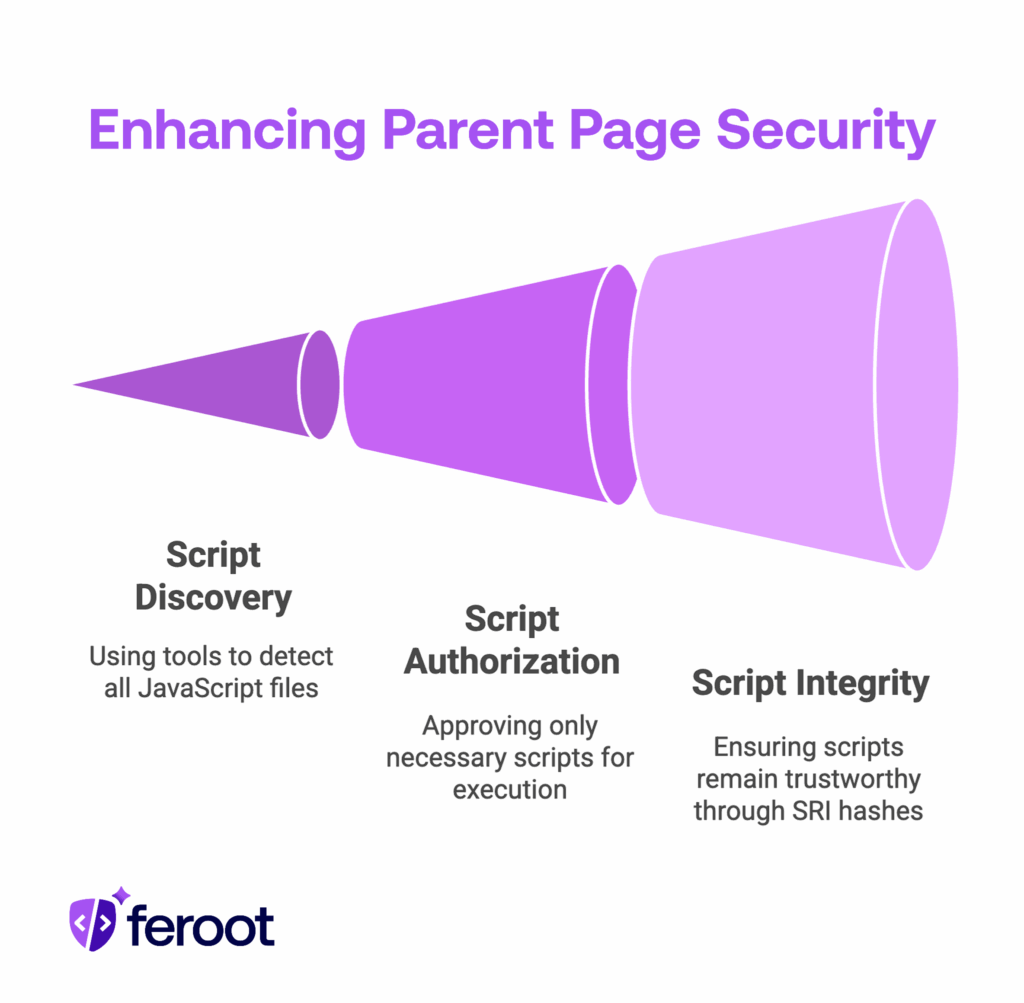
Start with script inventory
Run a script discovery scan using tools like Feroot to detect every JavaScript file loaded during checkout. In one real engagement, we found that a retailer’s “harmless” chat widget loaded an external analytics Software Development Kit that wasn’t documented anywhere. PCI DSS 6.4.3(a) requires you to know what is being executed in the browser.
Implement script authorization
Review your inventory and approve only necessary scripts. Enforce this using a Content Security Policy (CSP) that allows execution only from domains that are listed as safe.
Establish script integrity
Add SRI hashes, and integrate change-detection alerts into your Continuous Integration pipeline. This ensures that authorized scripts remain trustworthy between deployments.
Iframe configuration that satisfies auditors
In our experience, Qualified Security Assessors (QSA) care more about evidence of control than appearance. Here’s what they focus on:
1. Always use HyperText Transfer Protocol (HTTPS)
Every iframe source must load over HTTPS. Auditors will flag even one mixed-content request. In one assessment, a single HTTP image call inside an otherwise secure iframe triggered remediation. Keep all embedded endpoints encrypted to prevent Man-in-the-Middle (MITM) attack interception.
2. Set the correct security headers
QSAs consistently check for X-Frame-Options and Content-Security-Policy(CSP) headers. A properly configured CSP using frame-ancestors (e.g., Content-Security-Policy: frame-ancestors ‘self’ https://trusted.partner.com;) shows deliberate boundary control.
3. Use the sandbox attribute
Sandbox proves you’ve isolated risky functionality. Include only what’s essential. For example, <iframe src=”https://secure.example.com/form” sandbox=”allow-forms allow-scripts”></iframe>
Auditors often fail organizations for missing or overly broad sandbox permissions.
4. Monitor and audit behavior
Automate detection for new or modified iframe elements and track Document Object Model (DOM) changes in payment flows. PCI DSS 6.4.3 and 11.6.1 both require authorization, integrity validation, and real-time alerting.
Managing your vendor relationship
Even when payment handling is outsourced, accountability remains with you. PCI DSS 6.4.3 expects proof that vendor scripts and hosting are secure.
Documentation to request
Start by requesting your vendor’s PCI Attestation of Compliance, confirming their PCI scope and annual validation. You’ll also need data flow diagrams showing exactly where customer data travels, along with their change management policy describing how updates to hosted scripts are reviewed. Finally, ask for incident response commitments that outline breach notification timelines, typically within 24 to 72 hours.
How to structure vendor agreements
Your vendor agreements should include a right-to-audit clause that allows you to verify controls when needed. Require advance notice for any code or infrastructure changes, and mandate integrity monitoring and alerting for scripts served from the vendor’s domain. These provisions ensure you maintain visibility even when the technical implementation sits with a third party.
Red flags during vendor reviews
Watch for vendors who claim “We don’t store card data, so PCI doesn’t apply.” It still does under 6.4.3. Be cautious of vendors refusing to share testing or audit evidence, as this suggests gaps in their security posture. Frequent unannounced script changes or CDN shifts indicate weak change management, which creates compliance risk for your organization.
Your monitoring strategy
From an auditor’s point of view, “static compliance mindset” is never acceptable. What needs to be continuously monitored is every script, iframe source, and third-party domain that interacts with the payment page. The intent should be ongoing assurance, confirming that what you only approved is still what’s running today.
To ensure compliance, maintain integrity logs, alert records, and inventory snapshots showing version stability over time. This becomes your audit trail for 6.4.3 and 11.6.1.
Automatic content monitoring and tamper detection can help surface real-time changes. Platforms like Feroot, for instance, provide continuous visibility into browser-side activity. It alerts you when a new iframe appears or a script behaves unusually.
AI-powered alerts and visual risk maps can support this, but only if teams review them routinely. In our experience, a daily review for low/medium alerts and same-day triage for high-risk changes meets assessor expectations. As we often remind clients, technology helps you see risk faster, but it doesn’t own the responsibility.
See how Feroot keeps your payment pages compliant
Iframe compliance under PCI DSS 6.4.3 comes down to visibility and proof. Compliance becomes a predictable process when you understand which scripts operate on your payment pages, verify their integrity, and maintain continuous monitoring.
Feroot’s PaymentGuard helps teams sustain that control by:
- Continuously monitoring scripts and iframes for unauthorized changes.
- Detecting tampering or behavioral anomalies before they impact users.
- Providing audit-ready reports that prove ongoing compliance.
Ultimately, this is achievable. With the right visibility, your environment remains secure, your data is protected, and your audit conversations are straightforward.
See PaymentGuard in action. Schedule a demo.
FAQ
What is PCI DSS Requirement 6.4.3?
PCI DSS 6.4.3 requires organizations to inventory all scripts on payment pages, verify each is authorized for a valid purpose, and apply integrity controls to prevent tampering.
Does PCI DSS 6.4.3 apply if we use a third-party payment processor or iframe?
Yes. Even when data is handled externally, you remain responsible for browser-side content. PCI DSS 6.4.3 requires authorization and monitoring of every script that influences the payment experience.
Are payment iframes secure?
Not entirely. Only if implemented with proper isolation, vendor oversight, and monitoring. Following iframe security best practices under PCI DSS 6.4.3 ensures they perform as intended.


