
The US Department of Justice’s new Data Security Program (DSP) requires organizations to treat large collections of U.S.-person and government-related data as matters of national security.
In this post, you’ll learn:
- What “bulk sensitive personal data” covers and why it matters
- Why traditional data protection methods may no longer suffice
- A practical compliance framework your team can follow
- How readiness delivers ROI and avoids major risks
- Common missteps and a clear roadmap to get moving
How the DSP redefines the perimeter of data risk
In February 2024, Executive Order 14117 established that foreign states’ access to Americans’ “bulk sensitive personal data” or related government datasets poses an “unusual and extraordinary threat” to U.S. national security. Department of Justice
What this means in practice: if your organization handles substantial data (think biometric identifiers, health information, precise geolocation) and that data could be accessed by entities in designated “countries of concern,” the stakes go beyond compliance. They touch national defense.
The challenge is two-fold:
- Many teams still believe that strong encryption, standard privacy programs, or basic breach prevention are enough. Under the DSP, they are not.
- The rule doesn’t just apply to defence contractors. It extends to any company with significant sensitive U.S.-person or government-related data, or with vendor/investor links abroad. Foley Hoag
Consider this: data types you thought were safe, both anonymized or encrypted, can still fall under these rules if they meet the volume thresholds. The policy shift is clear: it’s no longer just about what you protect, but who might access it and how broadly it spreads.
Real risks, real exposure
To illustrate what’s driving this shift, here are some key facts:
| Data Point | What it means for you |
| The final rule prohibits or restricts “bulk U.S. sensitive personal data” transactions with certain countries of concern. National Law Review | Your vendor, investor, or partnership may now trigger national-security scrutiny rather than just privacy review. |
| “Bulk” thresholds: e.g., genomic data on 100+ U.S. persons or geolocation data for 1,000+ devices. BakerHostetler | Even data sets previously deemed low risk may now cross the line, and the count matters. |
| The definition covers anonymized, pseudonymized or encrypted data if the volume threshold is met. paulhastings.com | Relying purely on encryption or anonymization is no longer sufficient. |
These facts change the game: scope (bulk datasets), actors (vendors, investors, third-parties), consequences (national-security risk, not just privacy enforcement). That means your compliance strategy needs to evolve.
Understanding the DSP framework
We view the DSP as built around three foundational pillars. When mastered, they help you move from reactive protection to proactive defense.
| Pillar | Core Focus |
| Knowing your data | Map, classify, and continuously monitor what data you hold and how it flows. Do you hold biometric, genomic, health, geolocation, or financial data of U.S. persons or government-related personnel? |
| Assess transactions & access | Identify vendor agreements, investments, joint-ventures, or cross-border flows that could trigger a “covered data transaction” under the rule. National Law Review |
| Governance & controls | Build the policies and oversight on vendors, contracts, audit readiness, and board reporting. These are the evidences that your organisation must show. Department of Justice |
The aim: transform your organisation from seeing data merely as an operational asset to recognizing it as a strategic defense corridor to national security.
How to build your DSP compliance program
- Form a DSP Task Force.
Bring together Legal, Security, Marketing, Data Governance, Vendor Management, and Finance. Clarify who classifies data, who vets vendors, who tracks exposure abroad, and who certifies audits. - Inventory and classify data.
Identify datasets that may fall under “bulk sensitive personal data” or “government-related data”. Map where each dataset moves – collection, storage, processing, transfer, resale. Leverage automated tagging tools to reveal hidden flows. - Identify and prioritise covered transactions.
Review vendor contracts, investment or joint-venture agreements, and data-broker relationships. Screen for “countries of concern” (China, Russia, Iran, North Korea, Cuba, Venezuela) and assess which partners could expose data to them. White & Case - Update policies, contracts & training.
Embed contractual language aligned to the DSP; include audit rights, transparency obligations, termination rights, and cross-border transfer controls. Train vendor, procurement, and legal teams to recognise high-risk transactions. - Implement monitoring and audit systems
Deploy continuous monitoring of data flows and vendor exposures, especially parent-ownership links or covered-person status. Establish audit logs, policies and records that demonstrate good-faith efforts. Venable - Communicate, train & report.
Inform executive leadership and the board about DSP risks and program status. Train data teams, legal teams, and vendor partners. Monitor guidance updates from DOJ and related agencies. Faegre Drinker
This sequence turns a daunting regulation into a structured roadmap your team can execute with confidence.
Why DSP readiness pays off
Being DSP-ready builds operational resilience and market trust.
| Before Readiness | After Readiness |
| Data flows are opaque, vendor risk hidden | Full visibility into data pipelines, vendors and foreign exposure |
| Breach or regulatory fallout triggers privacy responses only | Clear governance over data movements and third-party relations |
| Contracts lack DSP-specific language | Contracts built with DSP in mind, reducing downstream surprise |
| Monitoring is reactive, and audit trails incomplete | Proactive audit posture, documented evidence of oversight |
From a purely business lens, civil penalties can exceed hundreds of thousands of dollars and criminal risk may apply. Department of Justice Moreover, demonstrating DSP readiness signals to customers, investors, and partners that your organization protects more than privacy but also extends protection to cover national interest.
Common pitfalls to avoid
- Assuming anonymized/encrypted data is exempt. It isn’t once thresholds apply. BakerHostetler
- Focusing solely on internal systems. Vendor, broker, investment and joint-venture risk may matter more.
- Thinking this is only for large enterprises. The rule applies to any entity handling U.S.-person or government-related data in a relevant transaction.
- Delaying vendor reviews and contract updates. When a transaction is flagged as prohibited, mitigation becomes more costly and complex.
- Ignoring audit and reporting timelines. The full compliance obligations (audit, certification, reporting) become effective after initial prohibitions. Privacy Matters
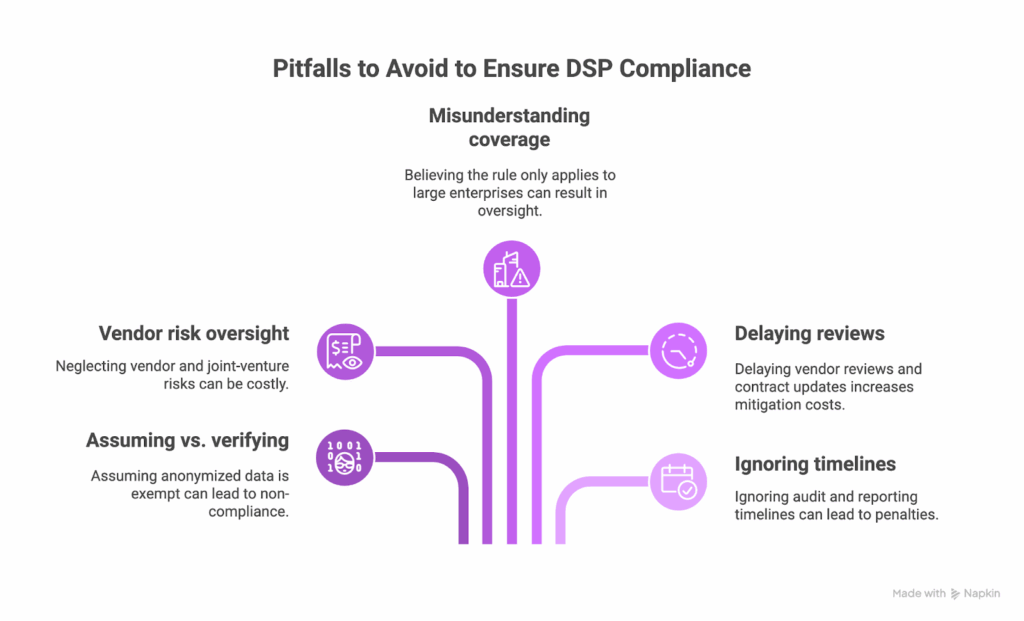
Skipping or delaying these areas doesn’t just increase regulatory risk; it also leaves your business vulnerable to strategic disruption and reputational harm.
Your 90-Day DSP Playbook
| Timeframe | Activities |
| Days 1-30 | Form your DSP Task Force; define roles and responsibilities; begin data inventory and classification; compile vendor/ investor list with foreign exposures. |
| Days 31-60 | Map data flows; identify high-risk “covered transactions”; review and draft updated contract language; develop monitoring and audit plan; select tools if needed. |
| Days 61-90 | Run a pilot audit of one key vendor/data flow; update training materials and conduct stakeholder training; establish an executive dashboard and reporting cadence; communicate status to senior leadership. |
After Day 90, your focus shifts to continuous monitoring, vendor lifecycle reviews, and preparation for full audit readiness ahead of the broader obligations in the months and years to come.
Frequently Asked Questions
Who must comply with the DSP?
Any U.S. person or entity, including foreign organizations with U.S. business operations that deals with bulk sensitive personal data or government-related data, and participates in data transactions involving countries of concern or covered persons. Department of Justice
Is anonymized or encrypted data exempt?
No. The rule applies regardless of whether the data is de-identified, encrypted, or pseudonymised, if the volume threshold is met and a covered transaction applies. McDermott
What kinds of transactions are prohibited or restricted?
Data-brokerage, vendor, employment or investment transactions that provide access by covered persons or countries of concern to bulk data sets. National Law Review
When did the DSP take effect?
The primary rule took effect on April 8, 2025; additional obligations (audit, reporting, certification) become effective October 6, 2025. Kirkland & Ellis
What is the best first step?
Start with a data-flow inventory and vendor/transaction review. This lays the foundation for assessing exposure and building your compliance plan.


